Python is a popular programming language. It was created by Guido van Rossum, and released in 1991.
It is used for:
web development (server-side),
software development,
mathematics,
system scripting.
What can Python do?
Python can be used on a server to create web applications.
Python can be used alongside software to create workflows.
Python can connect to database systems. It can also read and modify files.
Python can be used to handle big data and perform complex mathematics.
Python can be used for rapid prototyping, or for production-ready software development.
Why Python?
Python works on different platforms (Windows, Mac, Linux, Raspberry Pi, etc).
Python has a simple syntax similar to the English language.
Python has syntax that allows developers to write programs with fewer lines than some other programming languages.
Python runs on an interpreter system, meaning that code can be executed as soon as it is written. This means that prototyping can be very quick.
Python can be treated in a procedural way, an object-orientated way or a functional way.
Good to know
The most recent major version of Python is Python 3, which we shall be using in this tutorial. However, Python 2, although not being updated with anything other than security updates, is still quite popular.
In this tutorial Python will be written in a text editor. It is possible to write Python in an Integrated Development Environment, such as Thonny, Pycharm, Netbeans or Eclipse which are particularly useful when managing larger collections of Python files.
Python Syntax compared to other programming languages
Python was designed for readability, and has some similarities to the English language with influence from mathematics.
Python uses new lines to complete a command, as opposed to other programming languages which often use semicolons or parentheses.
Python relies on indentation, using whitespace, to define scope; such as the scope of loops, functions and classes. Other programming languages often use curly-brackets for this purpose.
Python File Handling
In our File Handling section you will learn how to open, read, write, and delete files.
The key function for working with files in Python is the open() function.
The open() function takes two parameters; filename, and mode.
There are four different methods (modes) for opening a file:
"r" – Read – Default value. Opens a file for reading, error if the file does not exist
"a" – Append – Opens a file for appending, creates the file if it does not exist
"w" – Write – Opens a file for writing, creates the file if it does not exist
"x" – Create – Creates the specified file, returns an error if the file exists
In addition you can specify if the file should be handled as binary or text mode
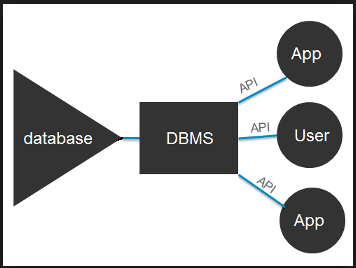
Introduction A database management system (DBMS) is system software for creating and managing databases. The DBMS provides users and programmers with a systematic way to create, retrieve, update and manage data.
Objectives of DBMS The following objectives are used in DBMS
Data availability-The data availability is responsible for the cost performance and the query update. Availability functions make the database available to users helps in defining and creating a database and getting the data in and out of a database.
Data integrity-The data integrity provides protection for the existence of the database and maintaining the quality of the database.
Data independence- DBMS provides two types of data independences. First is a physical data independence program, which remains unaffected from the changes in the storage structure or access method, and the second is the logical data independence program, which remains unaffected from the changes in the schema.
ACID Properties ACID properties are an important concept for databases. The acronym stands for Atomicity, Consistency, Isolation, and Durability. The ACID properties of a DBMS allow safe sharing of data. Without these ACID properties, everyday occurrences such using computer systems to buy products would be difficult and the potential for inaccuracy would be huge. The following basic concepts are used in database management systems (DBMS)
Atomicity
Consistency
Isolation
Durability
Atomicity The first ACID property is atomicity. When an update occurs to a database, either all or none of the update becomes available to anyone beyond the user or application performing the update. This update to the database is called a transaction and it either commits or aborts. This means that only a fragment of the update cannot be placed into the database, should a problem occur with either the hardware or the software involved. Features to consider for atomicity
It is maintained in the presence of deadlocks.
It is maintained in the presence of database software failures.
It is maintained in the presence of application software failures.
It is maintained in the presence of CPU failures.
It can be turned off at the system level.
It can be turned off at the session level.
Consistency Consistency is the ACID property that ensures that any changes to values in an instance are consistent with changes to other values in the same instance. A consistency constraint is a predicate on data which serves as a precondition, post-condition, and transformation condition on any transaction. Isolation The isolation portion of the ACID Properties is needed when there are concurrent transactions. Concurrent transactions are transactions that occur at the same time, such as shared multiple users accessing shared objects. Durability Maintaining updates of committed transactions is critical. These updates must never be lost. The ACID property of durability addresses this need. Durability refers to the ability of the system to recover committed transaction updates if either the system or the storage media fails. Features to consider for durability
Recovery to the most recent successful commit after an application software failure.
Recovery to the most recent successful backup after a disk failure.
Recovery to the most recent successful commit after a CPU failure.
Recovery to the most recent successful commit after a data disk failure.
Recovery to the most recent successful backup after a disk failure.
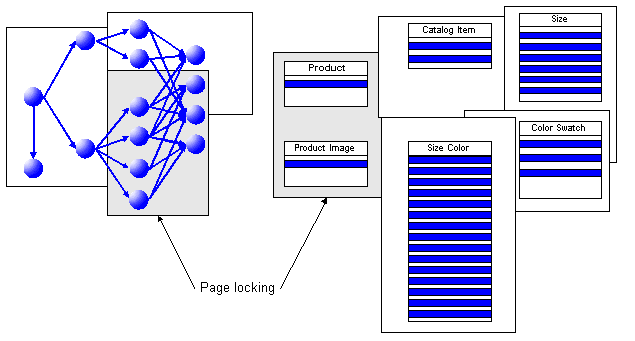
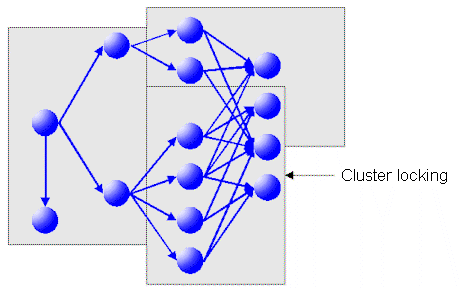
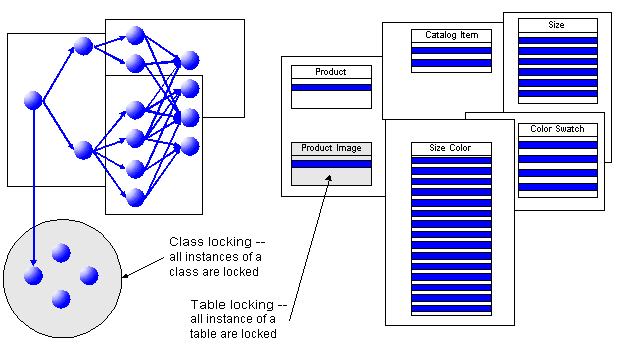
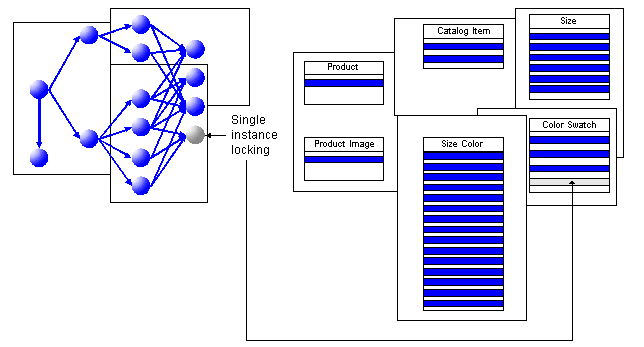
Concurrency Control and Locking Concurrency control and locking is the mechanism used by DBMSs for the sharing of data. Atomicity, consistency, and isolation are achieved through concurrency control and locking. The amount of data that can be locked with the single instance or groups of instances defines the granularity of the lock. The types of granularity are illustrated here are
Page Locking
Cluster Locking
Class or Table Locking
Object or Instance Locking
Page Locking Page locking (or page-level locking) concurrency control is shown in the figure below. In this situation, all the data on a specific page are locked. A page is a common unit of storage in computer systems and is used by all types of DBMSs. In this figure, each rectangle represents a page. Locking for objects is on the left and page locking for relational tuples is on the right. If the concept of pages is new to you, just think of a page as a unit of space on the disk where multiple data instances are stored.
Cluster Locking Cluster locking or container locking for concurrency control is illustrated in the figure below. In this form of locking, all data clustered together (on a page or multiple pages) will be locked simultaneously. This applies only to clusters of objects in ODBMSs. Note that in this example, the cluster of objects spans portions of three pages.
Class or Table Locking Class or table locking means that all instances of either a class or table are locked, as is illustrated below. This shows one form of concurrency control. Note the circle at the lower left. It represents all instances of a class, regardless of the page where they are stored.
Object or Instance Locking Instance locking locks a single relational tuple in an RDBMS or a single object in an ODBMS. This type of concurrency control is illustrated below.
Computer programming languages allow us to give instructions to a computer in a language the computer understands. Just as many human-based languages exist, there are an array of computer programming languages that programmers can use to communicate with a computer. The portion of the language that a computer can understand is called a “binary.” Translating programming language into binary is known as “compiling.” Each language, from C Language to Python, has its own distinct features, though many times there are commonalities between programming languages.
These languages allow computers to quickly and efficiently process large and complex swaths of information. For example, if a person is given a list of randomized numbers ranging from one to ten thousand and is asked to place them in ascending order, chances are that it will take a sizable amount of time and include some errors.
There are dozens of programming languages used in the industry today. We’ve compiled overviews of the 12 most important, relevant and in-demand of these languages below.
Python
Python is an advanced programming language that is interpreted, object-oriented and built on flexible and robust semantics.
WHO USES IT?
Professions and Industries:
Python developers, software engineers, back end developers, Python programmers
Used by employers in information technology, engineering, professional services and design
Major Organizations: Google, Pinterest, Instagram, YouTube, DropBox, NASA, ESRI
Specializations and Industries: Web and Internet development (frameworks, micro-frameworks and advanced content management systems); scientific and numeric computing; desktop graphical user interfaces (GUIs)
WHAT MAKES LEARNING IT IMPORTANT?
Python lets you work quickly to integrate systems as a scripting or glue language. It’s also suited for Rapid Application Develop (RAD).
The game Civilization 4 has all its inner logic, including AI, implemented in Python.
NASA uses Python in its Integrated Planning System as a standard scripting language.
Features:
Simple to learn and easily read
Associated web frameworks for developing web-based applications
Free interpreter and standard library available in source or binary on major platforms
Python was developed in the late 1980s at CWI in the Netherlands and first released to the public in 1991.
Java
Java is a general-purpose, object-oriented, high-level programming language with several features that make it ideal for web-based development.
WHO USES IT?
Professions and Industries:
Software engineers, Java developers
Used by employers in communications, education, finance, health sciences, hospitality, retail and utilities
Major Organizations: V2COM, Eclipse Information Technologies, eBay, Eurotech
Specializations and Industries: Internet of Things (IoT), Enterprise Architecture, Cloud Computing
WHAT MAKES LEARNING IT IMPORTANT?
Java is used to develop enterprise-level applications for video games and mobile apps, as well as to create web-based applications with JSP (Java Server Pages). When used online, Java allows applets to be downloaded and used through a browser, which can then perform a function not normally available.
Programs that use or are written in Java include Adobe Creative Suite, Eclipse, Lotus Notes, Minecraft and OpenOffice.
Java is the core foundation for developing Android apps.
Features:
Application portability
Robust and interpreted language
Extensive network library
WHERE DID IT START?
Originally known as Oak, Java was developed in 1990 at Sun Microsystems to add capabilities to the C++ language. Java was developed according to the principle of WORA (Write Once Run Anywhere). The language was introduced to the public in 1995 and is now owned by Oracle.
Ruby/Ruby on Rails
Ruby is an open-sourced, object-oriented scripting language that can be used independently or as part of the Ruby on Rails web framework.
WHO USES IT?
Professions and Industries:
Ruby on Rails developers, software engineers, data science engineers
Used by employers in technology, engineering, professional services, design, science and quality control
Major Organizations: Github, Scribd, Groupon, NASA Langley Research Center, Blue Sequence (part of Toyota Motor Manufacturing), Motorola, Google (SketchUp)
Specializations and Industries: Web App Development, Robotics, Networking, System Administration and Security
WHAT MAKES LEARNING IT IMPORTANT?
Ruby is used for simulations, 3D modeling, and to manage and track information.
Basecamp, Amazon, Twitter and Groupon were all created using Ruby on Rails.
NASA uses Ruby to conduct simulations.
Features:
Free to use, copy, modify and distribute
Intuitive and flexible language
Completely object-oriented (ability to use method chaining)
WHERE DID IT START?
Designed in 1995, Ruby’s creator described it as “simple in appearance, but it is very complex inside, just like our human body.”
TRY IT OUT!
Write a small program that formats a user’s input throughCODE ACADEMY
HTML (HyperText Markup Language)
HTML is the standard markup language used to create web pages; it ensures proper formatting of text and images (using tags) so that Internet browsers can display them in the ways they were intended to look.
WHO USES IT?
Professions and Industries:
Web developers, technical editors, email designers, software engineers
Used by employers in Information Technology, Engineering, Design, Professional Services, Management, Marketing, Customer Services and Sales
Major Organizations: Apple, CyberCoders, Apex Systems, CareerBuilder
Specializations and Industries Where HTML is Used Most: Web Development, Email Programming
WHAT MAKES LEARNING IT IMPORTANT?
HTML is used to create electronic documents (pages) displayed online. Visit any page and you will see an example of HTML in action.
The diversity and complexity in the structure and appearance of today’s sites is made possible with HTML.
Features:
Easy to use and learn the basics of HTML
Free and accessible
Multiple versions available
WHERE DID IT START?
HTML was created by physicist Tim Berners-Lee in 1990 to allow scientists to share documents online. Before then, all communication was sent using plain text. HTML made “rich” text possible (i.e. text formatting and visual images).
TRY IT OUT!
Write a recipe using HTML or pick another project atCODER PROJECTS
JavaScript
JavaScript is a client-side programming language that runs inside a client browser and processes commands on a computer rather than a server. It is commonly placed into an HTML or ASP file. Despite its name, JavaScript is not related to Java.
WHO USES IT?
Professions and Industries:
JavaScript developers, Web developers, software engineers
Used by employers in Information Technology, Engineering, Design, Marketing, Finance and Healthcare
Major Organizations: WordPress, Soundcloud, Khan Academy, Linkedin, Groupon, Yahoo and many others
Specializations and Industries Where JavaScript is Used Most: Front End Website Development, Gaming Development
WHAT MAKES LEARNING IT IMPORTANT?
JavaScript is used primarily in Web development to manipulate various page elements and make them more dynamic, including scrolling abilities, printing the time and date, creating a calendar and other tasks not possible through plain HTML. It can also be used to create games and APIs.
The agency Cyber-Duck in Britain uses public APIs, created with JavaScript, to pull in data about crime and enables users to review a local area.
Tweetmap, created by Pete Smart and Rob Hawkes using JavaScript, represents a world map that is proportionally sized according to the number of tweets.
Features:
Basic features are easy to learn
Multiple frameworks
Users can reference JQuery, a comprehensive Javascript library
WHERE DID IT START?
JavaScript was designed by Netscape and originally known as LiveScript, before becoming JavaScript in 1995.
TRY IT OUT!
Make a simple website with an image gallery or image slider atHTML-TUTS
C Language
C Language is a structure-oriented, middle-level programming language mostly used to develop low-level applications.
WHO USES IT?
Professions and Industries:
Software developers, computer engineers, business and systems analysts, IT and Web content administrators, embedded software engineers
Used by employers in Information Technology, Engineering, Management, Healthcare and Professional Services
Major Organizations: Microsoft, Apple, Oracle, Cisco, Raytheon
Specializations and Industries Where C Language is Used Most: Embedded Systems, Systems Programming, Artificial Intelligence, Industrial Automation, Computer Graphics, Space Research, Image Processing and Game Programming
WHAT MAKES LEARNING IT IMPORTANT?
C Language is used to develop systems applications that are integrated into operating systems such as Windows, UNIX and Linux, as well as embedded softwares. Applications include graphics packages, word processors, spreadsheets, operating system development, database systems, compilers and assemblers, network drivers and interpreters.
Facebook’s TAO systems is programmed mostly using C language.
Most device drivers are still developed using C Language.
Features:
Simple to learn; there are only 32 keywords to master
Easy to write systems programs such as compilers and interpreters
Foundational language for beginners
WHERE DID IT START?
The C Language was developed in 1972 at Bell Labs specifically for implementing the UNIX system. It eventually gave rise to many advanced programming languages, including C++, Java C#, JavaScript and Pearl.
TRY IT OUT!
Create a tic-tac-toe game usingOPENSOURCE CODE
C++
C++ is a general purpose, object-oriented, middle-level programming language and is an extension of C language, which makes it possible to code C++ in a “C style”. In some situations, coding can be done in either format, making C++ an example of a hybrid language.
WHO USES IT?
Professions and Industries:
C++ software engineers, C++ software developers, embedded engineers, programmer analysts
Used by employers in Information Technology, Engineering, Professional Services, Design, Quality Control and Management
Major Company and Organization Users: Google, Mozilla, Firefox, Winamp, Adobe Software, Amazon, Lockheed Martin
The C++ language is used to create computer programs and packaged software, such as games, office applications, graphics and video editors and operating systems.
The Blackberry OS is developed using C++.
The newest Microsoft Office suite was developed using C++.
Features:
Often the first programming language taught at college level
Quick processing and compilation mechanism
Robust standard library (STL)
WHERE DID IT START?
Released in 1983 and often considered an object-oriented version of C language, C++ was created to compile lean, efficient code, while providing high-level abstractions to better manage large development projects.
TRY IT OUT!
Create a student database or other similar system throughCODE IN CODE::BLOCKS
C#
Pronounced C-sharp (not C-hashtag), C# is a multi-paradigm programming language that features strong typing, imperative, declarative, functional, generic, object-oriented and component-oriented disciplines.
WHO USES IT?
Professions and Industries:
C# developers, automation test engineers, software engineers, senior .net Web developers
Used by employers in Information Technology, Engineering, Design, Professional Services, Management and Quality Control
Major Organizations: Microsoft Intel, Hewlett Packard
Specializations: Windows-based platforms
WHAT MAKES LEARNING IT IMPORTANT?
C# helps developers create XML web services and Microsoft .NET-connected applications for Windows operating systems and the internet.
Used to develop a wide range of software applications that accompany Visual Studio IDE.
The only language used by the Windows Presentation Foundation (WPF).
Features:
Similar to Java in capabilities
Ideal for beginners
The go-to for working on Microsoft apps
WHERE DID IT START?
C# was developed in 2000 as part of Microsoft’s release of .NET framework; in 2003 it became an ISO standard. C# was based off of C, C++, and Java languages.
TRY IT OUT!
Offers a free, extensive course in C# fundamentalsMICROSOFT VIRTUAL ACADEMY
Objective-C
Objective-C is a simple, general-purpose and object-oriented language. It uses a system of message passing borrowed from the language Smalltalk; when an object in Objective-C is sent a message, it can choose to ignore or forward to another object, rather than return a value.
WHO USES IT?
Professions and Industries:
IT and Web content administrators, iOS and Android mobile developers, software engineers
Used by employers in Information Technology, Engineering, Management, Healthcare and Design
Major Organizations: Apple, CyberCoders
Specializations: Software development
WHAT MAKES LEARNING IT IMPORTANT?
Objective-C is primarily used by developers to create apps for iOS and OS X.
From everything to Twitter and Facebook to Wells Fargo and Mint, objective-C is the most commonly used language to write programs for apple products.
Features
Increased flexibility with dynamic typing
Often used alongside a framework such as Cocoa or Cocoa Touch
Great first language for beginning programmers
WHERE DID IT START?
Objective-C was developed at Apple in 1983 to address deficiencies (specifically lack of object-orientation) in C language. It was licensed by NeXT in 1988.
TRY IT OUT!
Build a simple iPhone App with an open source tutorial atCODING GROUND
PHP (Hypertext Preprocessor)
PHP is an open-source scripting language designed for creating dynamic web pages that effectively work with databases. It is also used as a general-purpose programming language.
WHO USES IT?
Professions and Industries:
PHP developers, PHP software engineers
Used across industries, to include Information Technology, Engineering, Design, Professional Services, Healthcare, Management and Finance
Major Organizations: Facebook, Yahoo, CyberCoders, NextGen
Specializations Where PHP is Used Most: Web Application Development, Server-Side Scripting, Command Line Scripting
WHAT MAKES LEARNING IT IMPORTANT?
PHP is primarily used alongside dynamic data-heavy websites to collect form data. It’s also used in app development to generate dynamic page content.
PHP is part of the LAMP platform used by Facebook and Yahoo.
Platforms such as Joomla, WordPress and Drupal use the PHP language.
Features:
Easy to learn (as simple as embedding code inside HTML)
Free and opensource
Can be used on all major operating systems and web servers
WHERE DID IT START?
PHP was released in 1995 as a server-side scripting language, which is processed on a server to become a website in plain HTML.
TRY IT OUT!
Build a PHP/MySQL-powered forum using a free tutorial fromTUTS+
SQL (Structured Query Language)
SQL is a database query language (not a development language) that allows for adding, accessing and managing content in a database. It is the language that allows programmers to perform the common acronym CRUD (Create; Read; Update; Delete) within a database.
WHO USES IT?
Professions and Industries:
SQL server developers, database testers, software developers, database administrators
Used across industries like Information Technology, Engineering, Design, Management, Professional Servers, Business and Finance
Major Organizations: SQL is used by most companies and organizations that gather data. Examples include Robert Half Technology, Nigel Frank, CyberCoders and UnitedHealthCare.
Specializations Where SQL is Used Most: Data Analysis and Big Data Mining
WHAT MAKES LEARNING IT IMPORTANT?
SQL interacts with the backend database of web application. It is the “de facto standard” database language, always used in conjunction with another programming language. SQL programs are implemented as a way for businesses and organizations to access and manipulate information stored in their databases.
Relational database management systems that use SQL include MySQL (by Oracle), Sybase, Microsoft SQL Server and others.
Features:
Simple syntax
Free and easily accessible
WHERE DID IT START?
SQL was developed at the IBM Research Center in 1974 and originally known as SEQUEL. The first commercial version was introduced in 1979 by ORACLE.
TRY IT OUT!
Build a PHP/MySQL powered forum using a free tutorial fromTUTS+
Swift
Swift is Apple’s newest open-source, multi-paradigm programming language for iOS and OS X apps. Swift integrates Objective-C’s named parameters and object-oriented model, while including an advanced compiler, debugger and framework infrastructure.
WHO USES IT?
Professions and Industries:
Swift Platform Developers, iOS Mobile Application Developers, Software Developers, Senior Programmers, Data Engineers
Information Technology, Engineering, Design, Management and Professional Services
Major Organizations: Apple, Getty Images, Slack, Dow Jones, Playlist Media
Specializations Where Swift is Used Most: Software development
WHAT MAKES LEARNING IT IMPORTANT?
Swift is primarily used by developers to create apps for iOS and OS X.
Dow Jones is rewriting sections of its mobile Wall Street Journal app using Swift.
Getty Images built its consumer-facing app, Stream, using Swift.
Features:
Supports ‘playgrounds,’ a feature that lets programmers experiment and see immediate results
Easy to understand syntax
Ideal for writing production-ready code
WHERE DID IT START?
Swift, which is based off of the Objective-C programming language, was introduced at Apple’s 2014 Worldwide Developers Conference (WWDC). The newest version, Swift 2, was released as an open-source language in 2015.
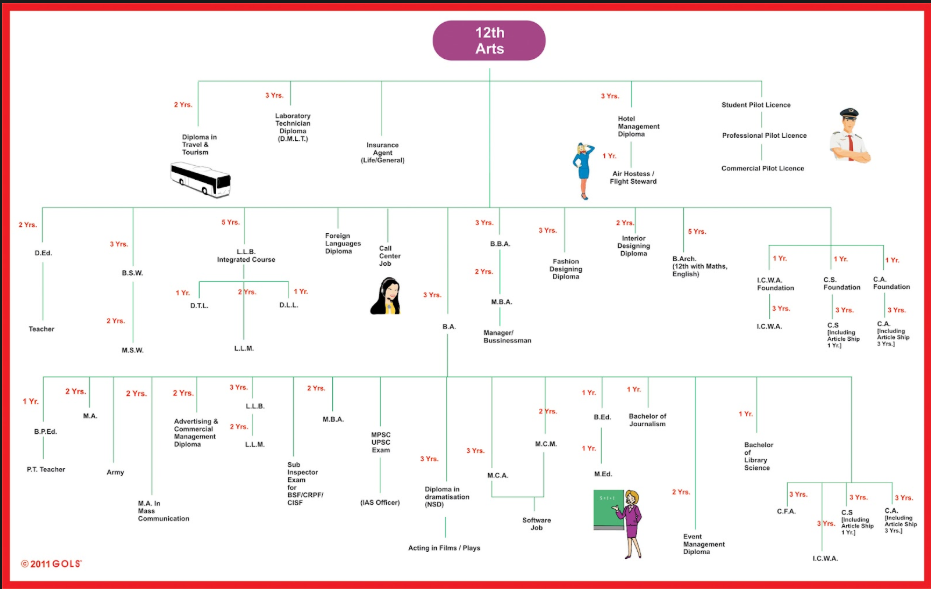
In this article, we will check out some best professional courses that 12th Arts stream students may pursue after their schooling. In this article, I’ve listed the courses and also provided course duration details. Towards the end of the article, a short explanation regarding career opportunities after 12th Arts stream is also given. Arts stream students will find this article very useful! Do read the entire post and choose a course that suits you best. And if you like my poor stick drawing that I’ve provided throughout the article, please do share them too!
TOP COURSES TO DO AFTER 12TH ARTS IN 2019 (LIST)-
Here are some good courses that one may do after 12th Arts-
B.A.– stands for Bachelor of Arts. Course duration is 3 years. The best thing about this course is that so many B.A. specialization courses are available to choose from. A general set of common B.A. subjects are present, in addition to which specialization subjects are also present. Some specialization areas are- B.A. Psychology, B.A. History, B.A. Archaeology, B.A. Economics, B.A. Journalism and Mass Communication, B.A. English, B.A. Hindi, B.A. Malayalam, B.A. in other languages (state wise), B.A. Sociology, B.A. Politics, B.A. Geography, B.A. Indian Culture, B.A. Social Work etc.
B.B.A.– stands for Bachelor of Business Administration. Course duration is 3 years.
B.M.S.– stands for Bachelor of Management Science. Course duration is 3 years.
B.F.A.– stands for Bachelor of Fine arts. Course duration is 3 years.
B.H.M.– stands for Bachelor of Hotel Management. Course duration is 3 years.
B.E.M.– stands for Bachelor of Event Management. Course duration is 3-4 years.
Integrated Law course– B.A.+L.L.B. Course duration is 5 years.
B.J.M.– stands for Bachelor of Journalism and Mass Communications. Course duration is 2-3 years.
B.F.D.– stands for Bachelor of Fashion Designing. Course duration is 4 years.
B.El.Ed.– stands for Bachelor of Elementary Education. Course duration is 4 years.
B.P.Ed.– stands for Bachelor of Physical Education. Course duration is 1 year.
D.El.Ed.– stands for Diploma in Elementary Education. Course duration is 3 years.
B.SW.– stands for Bachelor of Social Work. Course duration is 3 years.
Animation and Multimedia course. Course duration differs, but is generally between 1-3 years.
B.RM.– stands for Bachelor of Retail Management. Course duration is 3 years.
Aviation courses (Cabin Crew). Course duration is generally between 1-3 years.
B.B.S.– stands for Bachelor of Business Studies. Course duration is 3 years.
B.T.T.M.– stands for Bachelor of Travel and Tourism Management. Course duration is 3-4 years.
Those were some top professional courses that one could do after finishing 12th Arts stream schooling. Not only are the above mentioned courses being offered by a large number of Colleges in India, they are job oriented too. If you are interested, please give the next section a look. Over there, I’ve analyzed some professional courses in detail, which Arts stream students are eligible to pursue!
DETAILS OF SOME GOOD COURSES TO DO AFTER 12TH ARTS STREAM
1 B.A.
B.A. stands for Bachelor of Arts. It is one of the traditional professional courses that still many Arts stream students pursue. This course is 3 years long. B.A. students are supposed to go through a not too tough syllabus.
The advantage of selecting this course is that it is an easy to do Undergraduate program! You see, many Government jobs require applicants to be Graduates. So, if it is a Government job that you are targeting, you may pursue this course. It is an easy to pursue course and one may concentrate one’s efforts towards preparing for Government Job entrance exams!
Apart from the above mentioned advantage, there is another attractive advantage that this course offers- easy availability of seats and Colleges! Yes, throughout India, there are many Private as well as Government Colleges offering B.A. course. So, if one doesn’t want to leave one’s native place and pursue a professional course right there itself, this course could prove to be of help!
Talking about eligibility criteria in case of B.A., 12th Arts (or any other stream) students who have successfully cleared 12th standard examination from a recognized School may pursue this course!
After B.A., one may also go for M.A.! Doing so will enhance one’s skill set and market value! B.A. Graduates may land Government sector jobs such as in Banks, Armed Forces, Police Force, Administrative Office, Schools etc. They may also take up Private sector jobs such as- Accountants, Managers, Administrators etc.
Important subjects present in B.A. program-
English Language
History of Cultures
Introduction to Mechanics
Introduction to Graphics
Introduction to Design
Visual Arts studies
Study of Materials
Visual Perception
Workshops
Apart from the above mentioned common subjects, B.A. students then have to select a combination of courses that they have to pursue after the first year. Some of the important choices that they have are- Psychology, Archaeology, Economics, Mathematics, Languages (like Hindi, English, French etc), Sanskrit, Sociology, Indian Culture, Politics, Geography, History etc.
Fees: If you want to pursue BA course from a Government college, it will cost you a very low amount. Yes, Government BA colleges are known to charge very low tuition fees. Some State Govt institutes are known to charge around 5-10K INR per year. This figure may vary from one state to another.
On the other hand, private BA colleges are known to charge relatively higher tuition fees. On an average, it could be anywhere between 15-40K INR per year.
2 B.F.A.
B.F.A. stands for Bachelor of Fine Arts. Just like B.A., this professional course is also 3 years long course.
Talking about the syllabus, B.F.A. is all about study of visual forms of arts. For example, some of the areas of specialization within this course (and thus subjects) are- Painting, Sculpting, Music, Dance, Photography etc. According to me, this course suits students who are into the creative side of things!
I think students who are not too creative and those who don’t have skills in the above mentioned fields must not think about pursuing this course. Because, to succeed and thrive in this field after Graduation, creativity and skills are must haves!
When it comes to eligibility criteria, 12th Arts passed students may apply for B.F.A. There are many Private as well as Government Institutes offering B.F.A. course throughout India.
Fees: If you want to pursue this course from a private arts college, it will set you back by 10-40K INR per year. Tuition fees may vary from one college to another. It depends upon factors such as – type of college, its rating, scholarship status of the candidate, caste/category of the candidate etc.
Government arts colleges are known to charge relatively lower tuition fees. Some State Govt institutes charge around 2-5K INR per year for this course.
3 JOURNALISM AND MASS COMMUNICATION
This one is a job oriented and ‘in demand’ course. The Media sector is going through a phase of immense growth! Not only traditional forms of Media like print and TV, online media is also something that is catching up.
All this has resulted in increased number of job openings in Media sector! So, it is safe to say that Mass Communication professionals are in demand these days!
When it comes to Mass Communication, there are different types of courses available, like Degree, Diploma as well as Certificate courses. Degree course lasts 3 years. The duration of Diploma and Certificate courses ranges between 1-2 years.
Students who have a flair for Journalism, social activism etc will thrive in this field. Also, having good communications skills will be an added benefit!
12th Arts stream students who have successfully cleared board examinations may apply for this course. There are many Private as well as Government Institutes offering this course to students. Even there are institutes offering certificate as well as Diploma courses. Please make sure that those private institutes are recognized by the Government!
Talking about job opportunities after this course, Media houses are the prime recruiters. These days, thanks to the arrival of unconventional online media brands, a whole new set of job opportunities has also been unfurled in front of Mass Communication students!
Important subjects present in Journalism and Mass Communication courses-
Media Ethics
Mass Communication
Editing
Reporting
Languages and Translation
Communication Skills
Electronic Media
Print Media
Fees: Bachelor of Journalism and Mass Communication is the most popular journalism course in India. If you want to pursue this course from a private college, it will cost you around 30-80K INR per year. Private colleges charge relatively higher fees. On the other hand, Govt institutes charge low tuition fees. They usually charge around 5-15K INR per year. While at college, students will also have to face other forms of expenses such as – lodging fees, canteen fees, security deposit, library fees, exam fees etc. If you want to pursue a Diploma course related to journalism, it will set you back by around 20-50K INR per year.
4 HOTEL MANAGEMENT
Just like the previous entry, this one is also a job oriented course! It is a no nonsense course and trains students to take on managerial responsibilities in Hotel and hospitality Industry!
Course duration in case of Degree course is 3 years. Diploma courses are also available, whose duration ranges between 1-2 years.
With tourism sector of India going through a good phase, the Hotel business is also doing well. Government is also supporting tourism industry and thus it looks like Hotel business will continue this upward journey!
Skilled Hotel Management professionals are valued by Big and medium sized hotels. Five star and other high rated Hotels are the prime recruiters.
Arts stream students who have passed 12th standard examinations may pursue this course right after 12th!
Important subjects present in Hotel Management courses-
Communication Skills
Foreign Language
Food Production
Travel Management
Front Office Operations
Housekeeping
Management
Accounting
Nutrition and Food Science
Public Relations
Marketing
Some of the above mentioned subjects are recurring ones. Students will have to face them in more than one semester!
Fees: BHM (Bachelor of Hotel Management) is the most popular hotel management course in India. If you want to pursue this course from a private college, it will set you back by around 50-100K INR per year. If you choose to pursue this course from a Government college, it will cost you a significantly less amount.
Diploma in Hotel Management course will cost you around 25-50K INR (private colleges) per year. In short, tuition fees may vary from one institute to another.
5 B.B.A.
B.B.A. stands for Bachelor of Business Administration. It is a 3 years long course. If you want to take plunge into the world of management, this course could be of help!
After B.B.A., one may also go for M.B.A. (Master of Business Administration). B.B.A. graduates are usually hired by Corporate houses and Business firms to take care of managerial posts, finance related posts etc.
There is a notion that B.B.A. is meant for Commerce stream students. That is not true at all! Even 12th Arts students, who have cleared board examinations, may pursue this course!
Important subjects present in B.B.A. program-
Financial Management
Marketing
Economics
Human Resource Management
Accounting
Statistics
Entrepreneurship skills
Business Communications
In case of B.B.A. program also, some subjects are recurring ones. Students will have to deal with them in more than just one semester!
Fees: Top private BBA colleges usually charge around 70-150K INR per year. Tuition fees depends upon factors such as – type of college, rating of the college, scholarship status of the candidate etc. Govt colleges are known to charge significantly low tuition fees.
6 EVENT MANAGEMENT
Event Management is one such field where one can make it really big, if one has the necessary skills and connections! Degree course in Event Management lasts 3 years.
I’ve already written a detailed article about Event Management courses. In that article, I’ve covered details such as types of courses, career prospects, value of the course, nature of work involved etc.
In short, Event Management is a job oriented course, which even 12th Arts stream students may pursue after completing 12th standard schooling successfully.
Important subjects present in Event Management courses-
Study of main events
Planning
Human Resource Management
Accounting
Marketing and Advertising
Public Relations
Business Laws
Fees: BBA in Event Management course will set you back by 70-150K INR per year. Bachelor of Event Management course will cost you around 50-100K INR per year. If you go for Diploma in Event Management course, it will set you back by 25-70K INR per year. In short, fees may vary from one institute to another. It also depends upon the format of the course.
7 FASHION DESIGN
Just like BFA, to thrive in the field of Fashion Designing, one must possess creativity! If you think you are creative and have a taste for fashion, this course is for you!
Bachelor Degree program in Fashion Designing lasts 4 years. In this program, students are given theoretical knowledge as well as practical training!
12th Arts stream students who have successfully cleared their 12th board examinations are eligible to apply for this course.
Fees: If you want to pursue Bachelor of Fashion Design course, it will cost you around 50-100K INR per year (private colleges). B.Voc. Fashion Design course will set you back by 30-70K INR per year. Diploma programs usually cost lower than Bachelor’s Degree courses. Diploma in Fashion Design course will set you back by 25-50K INR per year.
8 RETAIL AND FASHION MERCHANDISE
This Degree course is also related to the Fashion Industry. But, unlike Fashion Designing, this course focuses on merchandising, marketing and selling of products related to Fashion Designing sector!
Duration of Bachelor Degree program is 4 years. 12th Arts stream, after clearing 12th standard examinations, are eligible to apply for this course!
9 INTEGRATED LAW COURSE
For Arts stream students, B.A. L.L.B. will be the best Integrated Law course that they could pursue! B.A. L.L.B. Integrated course’s duration is 5 years.
I’ve already written an article about Integrated Law courses, the way they work, career prospects etc. Do read it to get more detailed knowledge about this course.
Important subjects present in Law Course-
Constitutional Laws
Property Laws
Banking Laws
Environmental Laws
Company Laws
Consumer Protection Laws
Family Laws
Labour and Industrial Laws
Human Rights laws
Administrative Laws
Public International Laws
Recurring subjects are present in the above list. Students will have to face them in more than just one semester.
Fees: Tuition fees depends upon factors such as – format of the course, type of college, scholarship status of the candidate, rating of the college etc. Top LL.B. Colleges charge around 50-150K INR per year for this course. Government law colleges are known to offer this course at relatively lower fees. Some state Govt law colleges charge 5-10K INR per year for this course.
10 GRAPHIC DESIGN
Graphic design is a vast field. There are areas of specialization within this field. And based on these specializations, there are number of professional courses available too!
Some really good courses are- Animation, Graphic designing etc. Bachelor Degree course lasts 3-4 years. Diploma courses are also available, whose duration varies between 1-2 years.
This field is more suited for creative folks, who are also interested in sketching and visual arts.
Fees: If you want to pursue Diploma course related to graphic design, it will set you back by 20-50K INR per year. Course duration may vary from one institute to another. It depends upon the level of difficulty of the training program.
11 TEACHER TRAINING COURSES
Arts stream students have access to a handful of teacher training courses. Qualified teachers helps educate children and nurture them into good human beings! Teachers have their own place and status in the society. Teaching is a highly respected profession in India.
After 12th, Arts stream students may go for teacher training courses like- Integrated B.Ed. course, B.P.Ed. (Bachelor of Physical Education), B.El.Ed. (Bachelor of Elementary Education) or D.El.Ed. (Diploma in Elementary Education). Nursery level teacher training courses also exist in India.
JOB AND CAREER PROSPECTS AFTER 12TH ARTS-
Many parents and students claim that Arts stream is running out of/is already out of steam! How wrong they all are! In fact, many courses that one may pursue after 12th Arts are full of job opportunities. All one needs to have is a desire to achieve skills and go for higher studies or specializations if required.
If one want to have a career in Management sector after 12th Arts, he/she may go for management oriented courses such as- B.M.S., B.B.A., B.B.S. etc. Wow, just take a look at the number of management courses available at the disposal of Arts stream students! After acquiring management related skills, students may also go for specialization by selecting a hot and happening M.B.A. branch. This is how one may scale up the career ladder without any hassles! It is all about acquiring skills and specializing in good disciplines!
Let us talk about Bachelor of Arts course now. B.A. course could act like a spring board. It can be seen as a General Graduation program. After completing any B.A. program, students may take up jobs in the Government sector, for which, the minimum educational qualification is a Graduation Degree. There are various Government departments and sectors such as- Armed Forces, Railways, Administrative Offices, Civil Service posts, Municipal Bodies etc, where Graduates may find job!
If you are into the creative side of things, Fine Arts or Performance Arts courses could be of help.
If it is the Hospitality sector that you want to build a career in, Aviation courses, B.H.M. course, B.T.T.M. course etc could be of help. These sectors are going through phases of growth. Job opportunities created by them is also noticeable.
Looking for some exciting and rewarding alternate courses and career? Try courses related to Event Management, Fashion Designing, Interior Designing, Animation & Multimedia. How well you succeed in the above mentioned fields depends on your skills and passion.
Arts stream students may also pursue courses from other streams, such as- CA course (Chartered Accountancy), CMA (Certified Management Accountant), Bachelor of Statistics, Nursing (ANM or GNM) etc and build rewarding careers in those areas!
Elementary Education, Physical Education and Diploma in Elementary Education course will enable you to take up a teaching job.
Class 12 is a very crucial phase in a student’s life. At this stage, student make their career related choices which define their courses of life. Students taking science in class 11 have huge scope in future as the career options after 12 are numerous and varying. Here, some of the best courses after class 12 are mentioned which will give the students an in-depth insight and help them to choose their desired career path accordingly.
Every year students enrol for different courses in India like engineering, medical, law, etc. The graph given below depicts the total enrolment of students in the different courses after class 12 exam.
*This data is according to a news website.
In this article, the top courses after class 12 science are discussed which can help the science students to choose their preferred course accordingly.
First, what are the different science subjects?
There are a variety of subjects in science that the students can take up in their class 11. Among the various options, maths, physics, chemistry and biology are the most common ones. A graph is given below which reflects the total students who took the CBSE class 12 board exam of the main science subjects.
**This data is according to the CBSE website and the corresponding numbers represent the total registration in the corresponding subjects for the year 2017.
After 12th Science Courses List:
Among the various career scope in science, two of the most preferred fields are engineering and medical. Both these fields are highly competitive and offer excellent career opportunities. Both the fields have a different eligibility requirements which are mentioned below.
For engineering, students need to opt physics, chemistry and maths as main subjects and must pass the class 12th exam.
For medical career, students are required to opt biology compulsorily along with physics and chemistry and should pass their class 12 exam.
Total students graduating from engineering and medical are among the highest in India. A graph is given below which gives an overview of the total graduating engineers in the last 3 years.
There are several more career options for the science students after their class 12 exam. A complete list of career courses after class 12 are given in the tables below.
Top Courses after 12th Science:
Courses after 12th with PCM
Sl. No.
Course Name
Course Duration
1.
Engineering (B.E/ B.Tech)
4 years
2.
Integrated MSc
5 years
3.
Architecture (B.Arch)
5 years
4.
BCA
3 years
5.
B.Sc. in Nautical Science
3 years
6.
B.Sc. in Statistics
3 years
7.
Bachelor Programs in Economics
3 years
Courses after 12th with PCB
Sl. No.
Course Name
Course Duration
1.
MBBS
5.5 years
2.
BHMS (Homeopathy)
5.5 years
3.
BAMS (Ayurvedic)
5.5 years
4.
BUMS (Unani Medicine)
4.5 years
5.
BDS (Dental Surgery)
4 years
6.
BPT (Physiotherapy)
4.5 years
7.
B.VSc and AH (Veterinary Science & Animal Husbandry)
5 years
8.
B.Sc. Nursing
4 years
9.
B.Pharm (Bachelor of Pharmacy)
4 years
10.
BNYS (Bachelor of Naturopathy & Yogic Science)
5.5 years (including 1 year internship)
11.
B.Sc in Biotechnology
3 years
12.
B.Sc. Home Science
3 years
13.
BMLT (Medical Lab Technology)
3 years
14.
BOT (Occupational Therapy)
4 years
15.
B.Sc. Dairy Technology
3 years
Common Courses after 12th For PCM and PCB
Sl. No.
Course Name
Course Duration
1.
B.Sc
3 years
2.
B.A
3 years
3.
B.Com
3 years
4.
Bachelor of Law (LLB)
3 years
5.
ICWA Program
8 to 18 months depending on the course
6.
Media/ Journalism Courses
3 years
7.
Hotel Management
3 years
8.
B.Com
3 years
9.
Graphic Designing Course
4 years
10.
BCA
3 years
11.
Defence sector
–
12.
Fashion Technology (Bachelor of Fashion Technology)
4 years
13.
CA Program
–
14.
Travel & Tourism Courses
3 years
15.
B.Ed
2 years
16.
Bachelor of Applied Science
3 years
Diploma Courses after class 12th science
Sl. No.
Course Name
Course Duration
1.
Web Designing
1-2 years
2.
Fashion Designing
1 year
3.
Graphic Designing
1 year
4.
Mass Communication
1 year
5.
Textile Designing
1 year
6.
Computer Hardware
1 year
7.
Diploma in Software Engineering
3 years
8.
Event Management
1 year
9.
Hospital & Health Care Management
1 year
10.
Animation Film Making
–
These are a few courses after 12th science that the students can take. There are numerous other career options for the science students in India. Students are also suggested to check the eligibility criteria and other respective details of the courses properly before applying.
To get more career-related assistance, keep visiting BYJU’S. At BYJU’S, students are also provided with exam papers, sample papers and question papers of different boards.
As we have discussed above, anything that can store data can be called as a data structure, hence Integer, Float, Boolean, Char etc, all are data structures. They are known as Primitive Data Structures.
Then we also have some complex Data Structures, which are used to store large and connected data. Some example of Abstract Data Structure are :
Linked List
Tree
Graph
Stack, Queue etc.
All these data structures allow us to perform different operations on data. We select these data structures based on which type of operation is required. We will look into these data structures in more details in our later lessons.
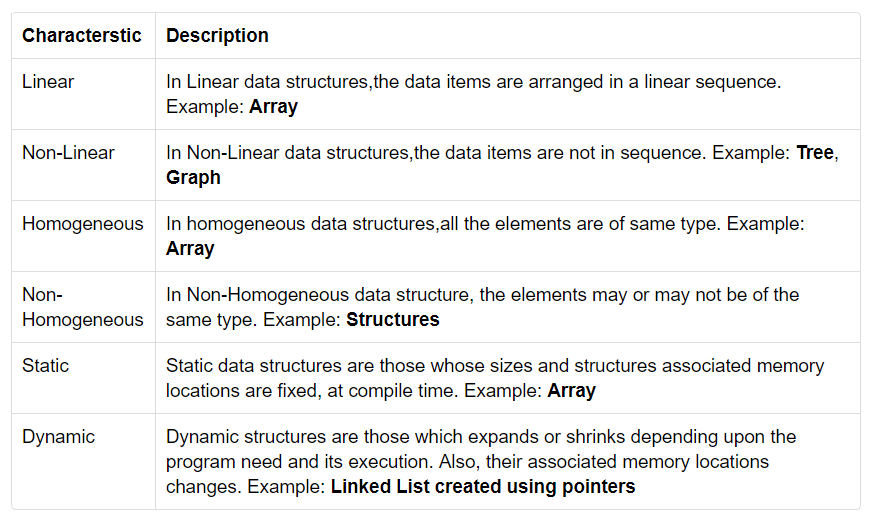
The data structures can also be classified on the basis of the following characteristics:
What is an Algorithm ?
An algorithm is a finite set of instructions or logic, written in order, to accomplish a certain predefined task. Algorithm is not the complete code or program, it is just the core logic(solution) of a problem, which can be expressed either as an informal high level description as pseudocode or using a flowchart.
Every Algorithm must satisfy the following properties:
Input– There should be 0 or more inputs supplied externally to the algorithm.
Output– There should be atleast 1 output obtained.
Definiteness– Every step of the algorithm should be clear and well defined.
Finiteness– The algorithm should have finite number of steps.
Correctness– Every step of the algorithm must generate a correct output.
An algorithm is said to be efficient and fast, if it takes less time to execute and consumes less memory space. The performance of an algorithm is measured on the basis of following properties :
Time Complexity
Space Complexity
Space Complexity
Its the amount of memory space required by the algorithm, during the course of its execution. Space complexity must be taken seriously for multi-user systems and in situations where limited memory is available.
An algorithm generally requires space for following components :
Instruction Space: Its the space required to store the executable version of the program. This space is fixed, but varies depending upon the number of lines of code in the program.
Data Space: Its the space required to store all the constants and variables(including temporary variables) value.
Environment Space: Its the space required to store the environment information needed to resume the suspended function.
To learn about Space Complexity in detail, jump to the Space Complexity tutorial.
Time Complexity
Time Complexity is a way to represent the amount of time required by the program to run till its completion. It’s generally a good practice to try to keep the time required minimum, so that our algorithm completes it’s execution in the minimum time possible. We will study about Time Complexityin details in later sections.
NOTE: Before going deep into data structure, you should have a good knowledge of programming either in C or in C++ or Java or Python etc.
C is a procedural programming language. It was initially developed by Dennis Ritchie between 1969 and 1973. It was mainly developed as a system programming language to write operating system. The main features of C language include low-level access to memory, simple set of keywords, and clean style, these features make C language suitable for system programming like operating system or compiler development. Many later languages have borrowed syntax/features directly or indirectly from C language. Like syntax of Java, PHP, JavaScript and many other languages is mainly based on C language. C++ is nearly a superset of C language (There are few programs that may compile in C, but not in C++).
Beginning with C programming:
Structure of a C program After the above discussion, we can formally assess the structure of a C program. By structure, it is meant that any program can be written in this structure only. Writing a C program in any other structure will hence lead to a Compilation Error.The structure of a C program is as follows:
The components of the above structure are:
Header Files Inclusion: The first and foremost component is the inclusion of the Header files in a C program. A header file is a file with extension .h which contains C function declarations and macro definitions to be shared between several source files.Some of C Header files:
stddef.h – Defines several useful types and macros.
math.h – Defines common mathematical functionsSyntax to include a header file in C:#include <(header_file_name).h>
Main Method Declaration: The next part of a C program is to declare the main() function. The syntax to declare the main function is:Syntax to Declare main method:int main() {}
Variable Declaration: The next part of any C program is the variable declaration. It refers to the variables that are to be used in the function. Please note that in C program, no variable can be used without being declared. Also in a C program, the variables are to be declared before any operation in the function.Example:int main() { int a; . .
Body: Body of a function in C program, refers to the operations that are performed in the functions. It can be anything like manipulations, searching, sorting, printing, etc.Example:int main() { int a; printf(“%d”, a); . .
Return Statement: The last part in any C program is the return statement. The return statement refers to the returning of the values from a function. This return statement and return value depend upon the return-type of the function. For example, if the return type is void, then there will be no return statement. In any other case, there will be a return statement and the return value will be of the type of the specified return-type.Example:int main() { int a; printf(“%d”, a); return 0; }
Writing first program: Following is first program in Cfilter_noneeditplay_arrowbrightness_4#include <stdio.h> intmain(void) { printf("GeeksQuiz"); return0; } Let us analyze the program line by line. Line 1: [ #include <stdio.h> ] In a C program, all lines that start with # are processed by preprocessor which is a program invoked by the compiler. In a very basic term, preprocessor takes a C program and produces another C program. The produced program has no lines starting with #, all such lines are processed by the preprocessor. In the above example, preprocessor copies the preprocessed code of stdio.h to our file. The .h files are called header files in C. These header files generally contain declaration of functions. We need stdio.h for the function printf() used in the program.
Line 2 [ int main(void) ] There must to be starting point from where execution of compiled C program begins. In C, the execution typically begins with first line of main(). The void written in brackets indicates that the main doesn’t take any parameter (See this for more details). main() can be written to take parameters also. We will be covering that in future posts. The int written before main indicates return type of main(). The value returned by main indicates status of program termination. See this post for more details on return type.Line 3 and 6: [ { and } ] In C language, a pair of curly brackets define a scope and mainly used in functions and control statements like if, else, loops. All functions must start and end with curly brackets.Line 4 [ printf(“GeeksQuiz”); ] printf() is a standard library function to print something on standard output. The semicolon at the end of printf indicates line termination. In C, semicolon is always used to indicate end of statement.Line 5 [ return 0; ] The return statement returns the value from main(). The returned value may be used by operating system to know termination status of your program. The value 0 typically means successful termination.
How to excecute the above program: Inorder to execute the above program, we need to have a compiler to compile and run our programs. Windows: There are many compilers available freely for compilation of C programs like Code Blocks and Dev-CPP. We strongly recommend Code Blocks.Linux: For Linux, gcc comes bundled with the linux, Code Blocks can also be used with Linux.
IAS is the short form of Indian Administrative Service.
It is one of the prestigious services among the 24 services like IPS, IFS etc for the which the UPSC conducts Civil Services Examination (CSE) for selecting the candidates.
An officer selected into the Indian Administrative Service gets exposure in very diverse roles like the collector, commissioner, head of public sector units, chief secretary, cabinet secretary etc.
Not only the experience and challenges but also the scope of making positive changes in the life of millions in India makes IAS a unique career choice.
Salary: The basic pay of entry level IAS officers is Rs.56100. The salary of civil servants (Salary = Basic Pay + DA + TA + HRA) will increase as experience increases. The basic pay of Cabinet Secretary is fixed at Rs.2,50,000.
How to become an IAS officer?
Even though the exam to be undertaken is popularly known as the IAS exam, it is officially called UPSC Civil Services Exam. The UPSC CSE consists of 3 stages – Prelims, Mains, and Interview.
Getting into Indian Administrative Service (IAS) is not easy considering the competition involved, but not impossible for a candidate with right attitude and approach.”
Civil Services Examination(CSE)
UPSC (Union Public Service Commission) is the government agency responsible for selecting the right candidates for this service. Every year only around 1000 candidates are selected for all the 24 services combined.
The number of candidates who applied for UPSC Civil Service Exam each year is approximately about 10 lakh, out of which around 5 lakh candidates appear on the exam day (prelims).
UPSC Civil Services Examination is widely considered as the toughest exam in the world, considering the exam duration (extends 1 year), depth of the syllabus and the competition involved.
The exam has 3 stages:
The first stage of the exam – Preliminary (objective) – is usually conducted around June.
The second stage, Mains (written), is conducted around September-October.
Those who clear Mains will have to face an interview/personality test during the March-May period.
The final result usually comes in May end.
Note: Check UPSC Civil Services Preliminary Exam 2019 Date
How to Clear Civil Services Exam?
To clear IAS Exam, aspirants are advised to have a long-term strategy. Though most of the serious candidates start preparation 9-12 months before the exam date, there are candidates who successfully achieve top ranks with only a few months of dedicated study.
If you are running short of time, you may read the two articles:
Civil Service Prelims 6 Month Strategy – How Can You Clear UPSC Prelims in 6 Months?
100-Days Action Plan to Clear UPSC Prelims
What matters in the UPSC Civil Services Exam is not the duration of the preparation, but the quality of the same.
A disciplined and focused mind with a passion for learning and reading is the basic trait of all successful candidates. The UPSC Civil Services exam is more a test of the analytic and presentation skills along with knowledge gained by the candidate rather than a test which checks a candidate’s mathematical or verbal skills.
To clear IAS, we feel two entities as essential:
Right guidance – for prelims and mains.
Right study materials and books.
“ClearIAS” is a humble attempt to provide aspirants with these two basic entities giving stress to self-study.
IAS Exam Eligibility Criteria
The educational qualification needed to appear in UPSC CSE is a degree (graduation) in any subject. Final year students can also apply. Aspirants may go through the article to the eligibility criteria for writing UPSC CSE exam.
IAS Exam Number of attempts permitted
The number of attempts permissible for a general category candidate in UPSC CSE is 6. For OBC candidates the number of attempts permitted it 9. SC/ST category candidates will have unlimited attempts till they attain the upper age limit to appear for UPSC CSE.
IAS Exam Age Limits
The minimum age to appear for UPSC Civil Services Exam is 21 years. Upper age limit for General category is 32 years, for OBC it is 35 years while for SC/ST it is 37 years.
IAS syllabus
A good understanding of UPSC syllabus and exam pattern is the first step for all freshers.
The Civil Services Preliminary exam comprises of two compulsory papers of 200 marks each (General Studies Paper I and General Studies Paper II). The questions will be of multiple choice, objective type. The marks in prelims will not be counted for final ranking, but just for qualification for the main exam.
A candidate’s rank in UPSC Civil Service Exam depends only on the mark scored in Main and Interview.
The written examination (main) will consist of the following nine papers, but only 7 papers will be counted for final merit ranking. For the rest two papers, the candidate should secure minimum marks prescribed by UPSC each year. The main exam has 1750 marks while interview has 275 marks.
IAS Coaching: Now prepare online for IAS exam
Classroom coaching is not a must to clear IAS.
Now websites like ClearIAS.com provide guidance outside the classroom coaching and free online study materials for those who can’t afford it due to time/financial constraints.
If the aspirant is dedicated and is properly guided, self-study is enough to clear UPSC CSE. You may also read our article: Can I clear the UPSC Civil Services exam without coaching classes?
Importance of mock exams
As you may know, only when tested in an exam atmosphere with negative marking, you can improve the ability to deliver in the actual exam hall.
Try for free the UPSC Prelims online mock exams by ClearIAS – in the new innovative platform which integrates learning with test-taking. You would be surprised to find how fast you can learn!
Books needed for Civil Services Exams
Taking inputs from toppers, a detailed list of the best UPSC books available in the market as per the latest UPSC syllabus for each subject in Prelims and Mains is prepared by us.
Aspirants may click on each link to buy books online at discounted prices.
IAS toppers
Read our UPSC topper’s interviews to know strategies straights from the horse’s mouth.
If you have more questions, please go through our article on Frequently Asked Questions(FAQs) about UPSC Civil Services Exam.
We on a regular basis update clearias.com website and ClearIAS mobile app with free online study materials to equip the bright minds across India clear IAS exam by self-study.
Don’t miss our easy-to-learn study materials, preparation strategies, topper interview, mock tests etc.
AdSense (Google AdSense) is an advertising placement service by Google. The program is designed for website publishers who want to display targeted text, video or image advertisements on website pages and earn money when site visitors view or click the ads.
The advertisements are controlled and managed by Google and Web publishers simply need to create a free AdSense account and copy and paste provided code to display the ads. Revenue using AdSense is generated on a per-click or per-impression basis. It is free to become a verified website publisher in the Google AdSense program.
Google currently offers a number of different AdSense programs, depending on the type of content you will place the ads on (e.g. webpage or RSS feed). Some of the more common programs include:
AdSense for content: display ads on a website
AdSense for search: display ads in search results on a website
AdSense for mobile: display ads on a mobile site
AdSense for feeds: display ads in RSS feeds
AdSense for domains: display ads on unused domains
AdSense programs are also available to qualified publishers and developers. Qualified publishers may use AdSense to drive revenues for iPhone applications, video or Web browser games. Google currently offers the following AdSense programs for qualified publishers:
AdSense for mobile applications: monetize Android and iPhone applications
AdSense for TV: monetize TV inventory
AdSense for video: monetize online video content
AdSense for mobile applications: monetize Android and iPhone applications
AdSense for TV: monetize TV inventory
AdSense for video: monetize online video content
AdSense for games: monetize browser-based games
Top Tips to Make Money with Google AdSense
Google AdSense is a advertising program that allows you to run ads on your website or blog, or YouTube videos, and get paid when when visitors click on them. The ads are generated from businesses that use Google’s AdWords program.
For new websites or blogs, the AdSense program can be one of the fastest ways to generate income, which is why it’s so popular.
But while AdSense is free and easy to use, there are aspects you need to understand about it, and things you can do to maximize your success with it.
Pros and Cons to Making Money with Google AdSense
The Google AdSense program has several great advantages including:
It’s free to join.
Eligibility requirements are easy, which means you can monetize your website or blog even when it’s new.
There are a variety of ad options and several you can customize to fit the look and feel of your site.
Google pays monthly (if you meet the $100 threshold) by direct deposit.
You can run ads on several websites from one AdSense account.
There are options to run ads on mobile devices and RSS feeds.
You can easily add it to your YouTube and Blogger accounts.
With that said, there are a few drawbacks to AdSense as well:
Google can terminate your account in an instant, and it’s not very forgiving if you break the rules.
Like all forms of online income, you need traffic in order to make money.
When people click on an AdSense ad, you do make some money, but your visitor also leaves your site, which means you lose the opportunity to make money with higher paying affiliate products or your own products and services.
It doesn’t necessarily pay more than other similar programs.
AdSense is a great monetization option, but it’s not a get-rich-quick or make-money-doing-nothing program. Further, Google has a lot of rules that aren’t always noticed upfront. As a result, many website owners have found out the hard way that they’d violated a Google policy, and have lost their account forever.
Types of AdSense Ads
Google offers a variety of ad types to run on your website, including:
Text: Text ads use words, either as an Ad Unit (one offer) or a Link Unit (list of offers), and come in a variety of sizes. You can customize the color of the box, text and link.
Images: Image ads are graphic ads. They come in a variety of sizes. You can choose an option that mixes both text and image ads.
Flash
Video
Rich media ads include HTML, Flash or other interactive feature.
Audio
AdSense for Search allows you to have a Google search box on your site. When a user enters a term and conducts a search, a search results page opens with AdSense ads. You can customize the color scheme of the search results page to harmonize with your web site.
Google AdSense Payments
Google pays monthly through direct deposit or check, but will not issue an AdSense payment until your earnings reach or exceed $100. If you don’t earn $100 in one month, your earnings roll over and are added to the next month. Each time you reach the $100 threshold, Google will issue a payment on the next payment period. Through your AdSense account, you can see your current earnings, what ads are generating the most clicks, and more.
Making Money with AdSense
Making a significant amount of money with AdSense requires a plan. Here are tips for maximizing AdSense revenue:
Read and adhere to Google’s rules. Webmasters must comply with Google’s webmaster policies as well as the AdSense program policy.
Don’t click on your own ads or ask others to click on them. Incentivizing clicks, buying Pay Per Click (PPC) space, or using a program designed to drive traffic to AdSense pages are against the rules. Remember, Google isn’t very forgiving about breaking the rules, so be sure to adhere to them.
Have great content your target market wants to read. Ultimately, money is made, whether through AdSense or other monetization methods, by providing valuable content and quality traffic to your blog or website.
Use honest, organic traffic building website marketing techniques, especially search engine optimization and article marketing.
Make sure your website/blog is optimized for mobile (responsive). The number of people who use mobile devices is high. Also make sure you’re using responsive ads, so Google can send appropriate ad sizes to mobile devices viewing your site.
Test ad types and placement to find the options that lead to the most income. Start with standard sizes (300×250, 728×90, and 160×600) as there will more ad options for Google to run.
Max out your ad placement. You’re allowed 3 standard ad placements per page. Use them all for maximum benefit.
Have ads above the fold (the part of your page first seen without scrolling).
Have a leader board ad below your header/logo instead of at the very top of the page, where it’s more likely to be noticed.
Include in-content ads for viability.
Monitor your results. Google can overwhelm you with tools and feedback, but do your best to check out what it says about your results so you can make the most of your effort.
Read email from Google, especially if it’s sending a warning about something it doesn’t like on your site. Failure to deal with Google’s complaints will lead to termination of the program.
Advanced AdSense Tips
Once you have ads running on your site, you’ll want to make sure you getting the most of your AdSense program. Here are some additional tips to consider when you’re ready to boost your AdSense income:
Run Experiments – You can A/B test your ads through AdSense.
Experiment with link and box colors – If you’re colors match your theme, consider changing them up to see if it impacts results.
Enable placement targeting – This allows advertisers to choose where their ads appear.
Set up custom channels so you can get a better sense of what’s working and not working
Dealing with Competitors’ or Questionable Advertisements
If you offer products or services on your website, you may find that some ads Google delivers come from your competitors. Another issue that can occur is ads that may not be completely legitimate or they might offend your market. To prevent these offers from showing up on your site, Google AdSense allows you to block up to 200 URLs from appearing on your site.
The challenge of this is two-fold.
You don’t know what ads are running on your site until you see them there. Plus, with each page load, and depending on the visitors browsing history, the ad may not show up again or it might appear in a different spot.
Since you can’t click on your own links (to the get the URL), you need to be careful about obtaining the URL to block. The best way to get the link so you can block it in AdSense is to right click the link, select “Copy Link Address,” and paste it into a document or text editor (i.e. Notepad). The Google URL is really long, but you’re looking for the section that identifies the advertiser. Copy that link, and paste into your AdSense blocked ads account.
Other Programs Besides AdSense
There are many ad network programs similar to AdSense, such as Media.net and InfoLinks. Some might require a traffic threshold, so you’d need to wait until your site is established before being accepted. Most have similar rules to Google, such as a limit to the number of the network’s ads per page (usually 3) and termination for clicking your own ads. In most cases, you can run different ad networks on your site without violating terms of service, but you’ll want to read the rules of each network before doing it.
Further, you want to avoid your site becoming so overwhelmed with ads that your readers can’t find the content.
Other Income Options besides Ad Networks
Ad networks, especially AdSense, are great options because you can join as a new blogger or website owner, and are easy to use. But they’re not the only ways to make money from your website. In fact, as your site traffic grows, other monetization options might be better. Here are some other money-making ideas you can use instead of, or along with, ad networks.
Affiliate Marketing: Like ad networks, affiliate programs are usually free to join and easy to add to your website.
Sell Your Own Product or Service: When you have a readership and social media following, you have an audience that trusts and likes you. As a result, they’re more open to buying directly from you. Creating your own product or service, as opposed to promoting someone else through affiliate marketing, can earn you significantly more money. This is especially true with information products or online courses that are inexpensive to create and sell. Other options include ebooks and freelance services.
Coaching or Consulting: As an expert in your topic, you’re in a good position to help people beyond the information you provide on your website/blog, to offer more in depth help through coaching or consulting.
Sponsors: When you have a good amount of traffic and terrific influence over your audience, other companies will pay to sponsor your website. They can sponsor your entire site, which would cost them more, or a single page. Some just have advertising.
As you can see, there are many ways to earn income from a website or blog. But many require that you have traffic and an audience that is paying attention to you before they make any money. This is where AdSense is a good beginning monetization option. You don’t have to create anything, it’s free to join, and it’s easy to add the ad code to your website.
















 WorldBlogs